
How to Capture Summer Magic — Even When the Skies Refuse to Cooperate
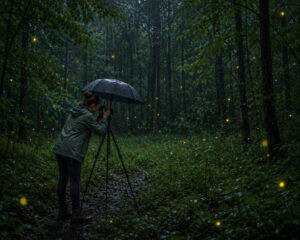
Unfortunately for photographers, firefly season often arrives alongside humidity, fog, mist… and endless rain. (At least here in Pennsylvania lately.)
The good news? You can absolutely photograph fireflies in both dry and rainy conditions — and rain can actually add atmosphere, reflections, depth, and mood to your images if you work with it instead of against it.
Here are some of my favorite tips for photographing fireflies — with and without the rain.
Scout Your Location Before Dark
Fireflies usually gather in:
- Woodland edges
- Broadleaf forests
- Meadows
- Wet areas near streams or ponds
- Tall grass clearings
If possible, visit your location before sunset to:
- Check footing and trails
- Set up safely
- Identify compositions
- Avoid fumbling in the darkness
Rainy nights make this even more important because mud, roots, and slick leaves become hazards very quickly.
Use a Tripod (Always)
Firefly photography almost always requires long exposures.
Even if you have excellent image stabilization, a tripod is essential for:
- Sharp trees and landscape detail
- Layered firefly trails
- Multiple stacked exposures
- Lower ISO noise
A sturdy tripod matters even more in wet weather where soft ground can shift underneath lightweight setups.
Rain Can Actually Improve the Mood
Most photographers pack up when the rain starts.
But light rain can create:
- Reflective foliage
- Atmospheric haze
- Depth from falling droplets
- Softer contrast
- More cinematic light
A gentle straight-down rain in a forest can become part of the image itself — especially when illuminated by ambient sky glow or distant artificial light.
The key is light rain.
Heavy downpours usually obscure fireflies and create excessive blur and lens spotting.
Protect Your Camera Gear
You do not need expensive specialty rain gear.
Simple solutions work beautifully:
- Small umbrella clamped to tripod
- Compact tarp over camera
- Rain sleeve
- Microfiber cloths in your pocket
- Lens hood to reduce raindrops on glass
One of the simplest setups is a small umbrella angled over the tripod and camera while you stand beside it adjusting settings.
It may not look glamorous — but it works.
Camera Settings for Fireflies
A good starting point:
- Mode: Manual
- Focus: Manual focus
- ISO: 800–3200
- Aperture: f/2.8 – f/5.6
- Shutter: 10–30 seconds
Experiment depending on:
- Firefly activity
- Ambient light
- Rain intensity
- Whether you want trails or floating points
For glowing “dots”
Use shorter exposures.
For magical drifting streaks
Use longer exposures or stack multiple frames.
Focus Before It Gets Fully Dark
Autofocus struggles badly in low-light woodland environments.
Before darkness fully falls:
- Focus on a tree trunk
- Focus on your intended foreground
- Switch lens to manual focus
- Leave it there
This prevents the camera from endlessly hunting once the fireflies appear.
Fireflies Often Peak After Humid Rain
Warm humid evenings after rain can produce incredible activity.
Some of the best conditions include:
- Warm temperatures
- High humidity
- Calm winds
- Misty air
- Wet vegetation
Ironically, the nights photographers often avoid can become the most magical.
Include the Environment
A common mistake is photographing only the fireflies.
Instead, include:
- Tree silhouettes
- Paths
- Ferns
- Wet leaves
- Reflections
- Fog
- A human figure for scale
Fireflies become far more powerful when they exist inside a scene rather than floating in empty darkness.
Watch for Lens Fogging
Humidity is often a bigger issue than rain itself.
To reduce fogging:
- Keep gear acclimated outdoors
- Avoid opening bags constantly
- Use lens cloths frequently
- Store silica packs in camera bag
Moving repeatedly between air conditioning and humid outdoors can instantly fog lenses.
Respect the Fireflies
Avoid:
- Flash photography directly into swarms
- Trampling habitat
- Excessive bright lights
- Catching large numbers in jars
Firefly populations are declining in many regions due to habitat loss and artificial light pollution.
Photograph gently and leave the environment as you found it.
Final Thoughts
Some of my favorite images happen when conditions are imperfect.
A little rain. Fog drifting through trees. Muddy boots. Damp sleeves. Fireflies glowing against wet leaves.
Those nights feel less like photography and more like stepping briefly into another world.
And honestly? Sometimes the rain is exactly what the image needed.
Happy Hunting… Kathy